
Should Christopher Nolan Adapt The Prisoner?
And why does he even want to?

Back in 2024, before it was publicly known that Christopher Nolan’s mystery project would be an adaptation of Homer’s Odyssey, rumors abounded as to the film’s subject. Some people said it was a Blue Thunder-esque drama about helicopter pilots. Others claimed it was a horror movie about vampires. Around this time, I got a text message from a friend who I’ll keep anonymous. They said that they had it on good authority that Nolan was adapting the 60s British spy series The Prisoner. Nolan had been connected to the show before. A year after achieving his first mega-blockbuster hit with The Dark Knight, he attached his name to a Prisoner film adaptation but opted to make Inception instead. Later that year, an American miniseries remake starring Jim Caviezel and Ian McKellan flamed out on AMC, and big screen plans were subsequently shelved. A fifteen-year gap seemed a plausible amount of time to reset public perception of the material, and the runaway success of Oppenheimer meant Nolan had his blankest check since The Dark Knight. My friend’s information seemed believable.
That alleged helicopter-vampire-Prisoner film turned out to be The Odyssey, as we all now know. But Nolan probably was working on something related to The Prisoner at the time. His association with the project in 2009 was how he first met Donna Langley, chairwoman of Universal, a relationship that paid dividends when Nolan had his acrimonious split with Warner Bros. in 2021. It’s not hard to imagine Nolan and Langley picking up where they left off with a Prisoner project. He’s been talking about wanting to do it since at least 2006, when he said that 12 Monkeys screenwriters David and Janet Peoples were actively working on a script for him.
What draws Nolan to The Prisoner? The show, which premiered in 1967 (three years before Nolan’s birth), was the creative brainchild of its star Patrick McGoohan. Coming off the success of his spy thriller series Danger Man, McGoohan wanted to use the mold of the espionage genre to tell a much stranger kind of story. The Prisoner begins with the impassioned resignation of McGoohan’s nameless British espionage agent (some fans read this character as literally being the same person McGoohan played in Danger Man, others consider this only a metatextual lens through which the series can be read), shortly after which he is kidnapped and taken to a mysterious place called The Village. Everyone in The Village is identified by a number—McGoohan is told he is Number Six—and forbidden from leaving, though few residents express a desire to do so. Six is told by Village leader Number Two that he is being held in order to elicit secret information from his time as a spy. Their chief question: Why did he resign? As the show goes on, Number Two comes up with schemes to psychologically break Six or otherwise deceive him into divulging his secrets, while Six uses his cunning to deny the attempts.
It’s a good premise for a spy show, but The Prisoner has much more on its mind aesthetically and thematically. The surreality of The Village is so intense that Six’s problems tend to come across as much more allegorical than the kind of concrete espionage obstacles one might have found on Danger Man. It quickly becomes clear that there is no way to tell whether or not the hundreds of other Village residents are all former spies, or normal people, or paid actors, or perhaps even, to a man, agents of whatever unidentified group runs this place, every single one of them acting to the sole purpose of breaking Six. Nothing in The Village is constant enough to be tangibly understood; even the autocratic Number Two is replaced and played by a new actor in almost every episode. While early episodes feature a lot of doomed escape attempts by Six, after a little while leaving The Village becomes less of an active concern. Six is bound there not by any logical mechanisms which can be physically confronted or outwitted, but by a much more daunting Something Else. The schemes by the Twos become more abstract as well, inflected with sci-fi tropes in some cases and featuring ludicrously convoluted psychological manipulation in others.
The Prisoner tends to be read as a critique of 60s counterculture movements, with Six acting as the consummate capital-I Individual in opposition to the faux-collectivist totalitarianism of The Village. Even more than that, though, the show is sharply critical of espionage as an institution at a time when it was being depicted glamorously not just by television shows like Danger Man and Mission: Impossible but much more prominently by the early James Bond films. The most interesting dynamic on the show is that Six is totally open with Number Two about why he resigned. He says plainly that he was done with spy work—it’s implied, but never outright stated, that he may have had some moral qualms about his directives—and he wanted to take a break, do something else, go on vacation. The various Number Twos refuse to accept the simple humanity of this answer. They have no theory of mind for Six, cannot process that he isn’t playing some kind of elaborate mind game to the benefit of a secret agenda. What keeps Six prisoner is espionage itself, this way of understanding the world that cannot incorporate basic human desires. When Six declares in the show’s intro sequence that “I am not a number! I am a free man!” it’s him raging against The Village’s depersonalized communal dystopia, to be sure, but it’s also a refutation of the way Western intelligence communities organized and manipulated society.
Does this answer the question of what draws Christopher Nolan to the material? Not on its face. Nolan’s chief concerns as a filmmaker are well established, and I will list the top three here:
The way film editing allows for the manipulation of time such that events in different chronologies can seem to occur simultaneously
The painful reverberations of reckless actions into an unknown future
The sacrifice of personal relationships to obsessively pursue one’s ambitions
Point one: While The Prisoner is famous for its loose approach to chronology—besides the first episode and the last two, the series can be coherently watched in literally any order—it’s not a work overly concerned with the kind of shifting timelines Nolan loves. The story is by nature locked to Six’s perspective, denying us peeks into the interiority of literally any other character. This makes the inclusion of any cross-cutting an unlikely proposition.
Point two: While The Prisoner was prophetic about our modern surveillance state and the encroaching power of intelligence agencies, it’s very much a work of its moment, without much time spent on historical context. The show is ultimately more interested in Six’s psychological culpability in his own imprisonment rather than his (or anyone else’s) impact on the wider world.
Point three: I mean, Number Six literally just wants to relax and go on vacation.
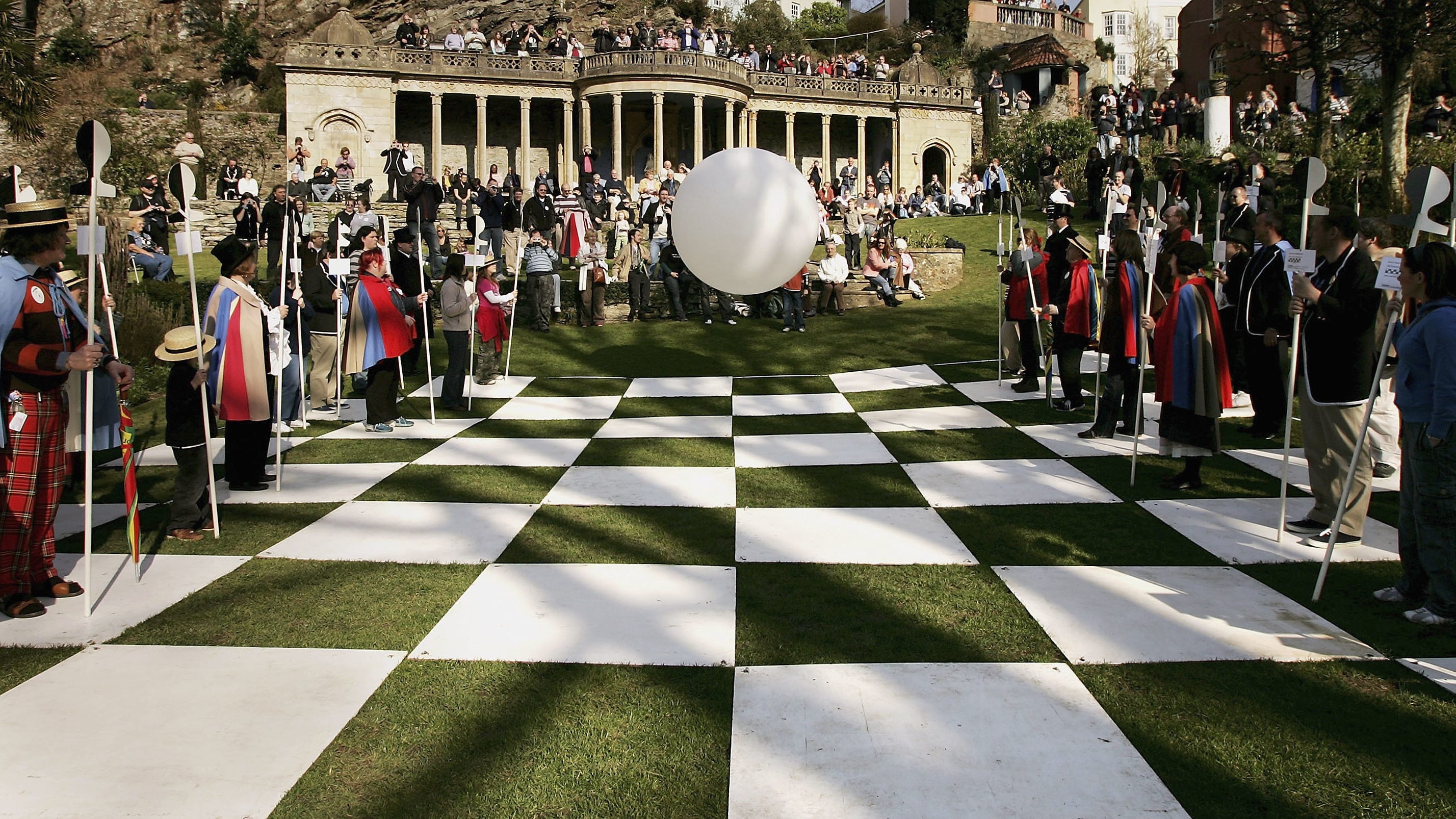
This does seem, on the face of it, to be a mismatch of artist and project. That’s not to say that Nolan is incapable of exploring new ideas in his work, but the problem of locating his interest in The Prisoner remains unaddressed. More significant a misalignment is with McGoohan’s aesthetic sensibilities. The Prisoner is gonzo television, fearlessly surreal and comic. The second episode of the show (in my watch order, anyway), a moment when most television would be settling viewers into a familiar rhythm, is an extended baroque allegory for the central conflict of the rest of the series. The series is shot at a beautifully kooky Welsh folly village which has been dressed to look comedically generic—signs for each building read like “The General Store,” as though each one is the ultimate Platonic example. The Village is protected by a giant white balloon called Rover which lets out a terrifying roar and chillingly engulfs attempted escapees. There are episodes where Number Two spies on Six’s dreams for information, where a clone of Six is introduced and the real Six is gaslit to believe he is someone else, where Six has his mind swapped into someone else’s body and is sent back to England, an episode that takes place in the Old West…. Does this sound like it would suit the artistic inclinations of a man who is so frequently embarrassed by depictions of the mystical, the strange, the heightened? The man who opened his Odyssey film with “In a time of apparent magic”?
There is one idea, though, which occurred to me only in the middle of writing this, that I think would be the core of a Nolan Prisoner adaptation. In his early films, there’s a repeated motif of the “lie told for the right reasons,” the Noble, or at least Practical, Deception. The Dark Knight ends with Batman taking the fall for Harvey Dent, creating a fictional narrative which he thinks will serve the people of his city better than the truth; earlier in the film, Dent takes the fall for Batman as part of a ruse to capture the Joker. In Interstellar, Michael Caine’s Professor Brand lies that the purpose of the space mission is for the astronauts to ultimately return home and take humans to a new planetary home, believing correctly that people would be more willing to work together to save themselves than to save the abstract concept of the human race. The Prestige makes much of the productive deception of stage magic, and Inception concerns the fabrication of a cathartic reunion to trick a man into making an unlikely business decision. It’s a little more complicated than simply endorsements of deception, but Nolan did once seem to believe that lies could have, if not necessarily moral value, at least social utility.
Now he’s made The Odyssey, an adaptation featuring the most famous liar in the history of literature, and he’s made it about the socially corrosive nature of perfidy. In 2026, Nolan can only see the Trojan Horse (one of history’s most prominent Noble Lies) as an act of violence so destabilizing that it exploded an entire era of human civilization. He no longer seems to believe in the practicality of a comforting fiction or a societally productive myth, even in a shrugging “it’s complicated” way.
And isn’t this dynamic precisely described by the arc of Number Six? This man acted as an agent of empire, employing craft and duplicity against other human beings, and while we never learn what instigated his furious retirement, it seems undeniable that he had a change of heart. Six does not want to be a spy anymore, and his world finds this so impossible to accept that it traps him in a place where everything and everyone lies as a matter of course. We could imagine this happening to Odysseus after the credits roll, picture him landing his ship on the shore of The Village somewhere past the sunset.
I don’t think a Christopher Nolan film of The Prisoner would be all that good. It would lose too much for his squirminess around surreality and insistence on foregrounding capital-T Themes. One shudders to imagine his gritty, realistic take on Rover, or the cold unfriendliness of his Village. I do think, though, that there is a way to fit his artistic predilections into a Prisoner-shaped container.
A Nolan Prisoner perhaps would more explicitly concern Six’s remorse. It would open with the mission that broke his faith in his country and in intelligence apparatuses. The Village he’s taken to would more directly reflect his psychology—he would recognize things from his former life there and understand that they are meant to trigger his guilt. He would clash with a single Number Two, whose main trait will be a callous disregard for human life more than a pompous authoritarianism. Six will have an ally secretly helping him plot an escape who is inevitably revealed to have been an agent of The Village all along. The film would conclude with Six finally escaping only to find that the outside world has become a totalitarian panopticon. As a direct result of his work as a spy, the entire world has become The Village. Roll credits.
—Capybaroness, 2026